
From "make waiting feel better" to two working prototypes in two branches.
A vague brief about "perception of waiting" reframed into two specific service breakdowns, then resolved with two named prototypes deployed live in real branches.
- Client
- Ferguson Enterprises
- Year
- 2022
- Role
- Solo Service Designer
A $20B distributor asked for a way to “make waiting feel better.”
The Pro Pickup, or PPU, is the moment a contractor walks into a Ferguson branch to collect an order they placed by phone or email. Ferguson wanted customer satisfaction in that moment to improve. The way they framed the problem was the perception of waiting.
That brief is straightforward in shape and slippery in substance. “Perception of waiting” sounds like a problem but isn’t yet a design target. Waiting where? Waiting because of what? Waiting that costs the customer what?
The work sat inside Ferguson’s CX team, partnered with their internal service design lead. Solo on the design side, part time, with little outside oversight. The early job was less about producing prototypes and more about figuring out what problem to actually solve.
A seven-phase framework, built while running it.
- 01 Monitor & Frame
- 02 Explore & Identify
- 03 Ideate & Visualize
- 04 Prototype & Envision
- 05 Experiment
- 06 Refine
- 07 Optimize
In practice this meant three layers of participants doing different work at different times. A Subject Matter Expert Advisory Group, drawn from store operations, sales, merchandising, and customer experience, gave continuous feedback across the whole project. Beneath them, two Ideation Teams ran in parallel, one per scenario, generating concepts through Crazy 8s, Round Robin, affinity mapping, and elevator pitches. Those teams later evolved into Prototyping Teams that took the strongest concepts and built them into testable services using Service Envy, storyboarding, Cupcake Canvas, and body storming.
The cadence was a couple of hours of facilitated work each month, sustained over the better part of a year. Mostly remote, anchored in Miro, with hybrid sessions when teams were colocated. Every workshop board, activity, and toolkit was designed from scratch.
Two pieces of upstream work shaped everything that came after. The first was a Pro Pickup service blueprint that mapped what was supposed to happen at every step. The second was a workshop that produced eight Counter Experience Principles: enable a frictionless ordering experience, value time, enable project success, in the moment, trusted advisor, unlock expert collaboration with information, provide value from start to finish, and a partnership-oriented principle around being valued rather than just transacted with. The principles weren’t decoration. They became the rubric the prototyping teams used to evaluate every concept.
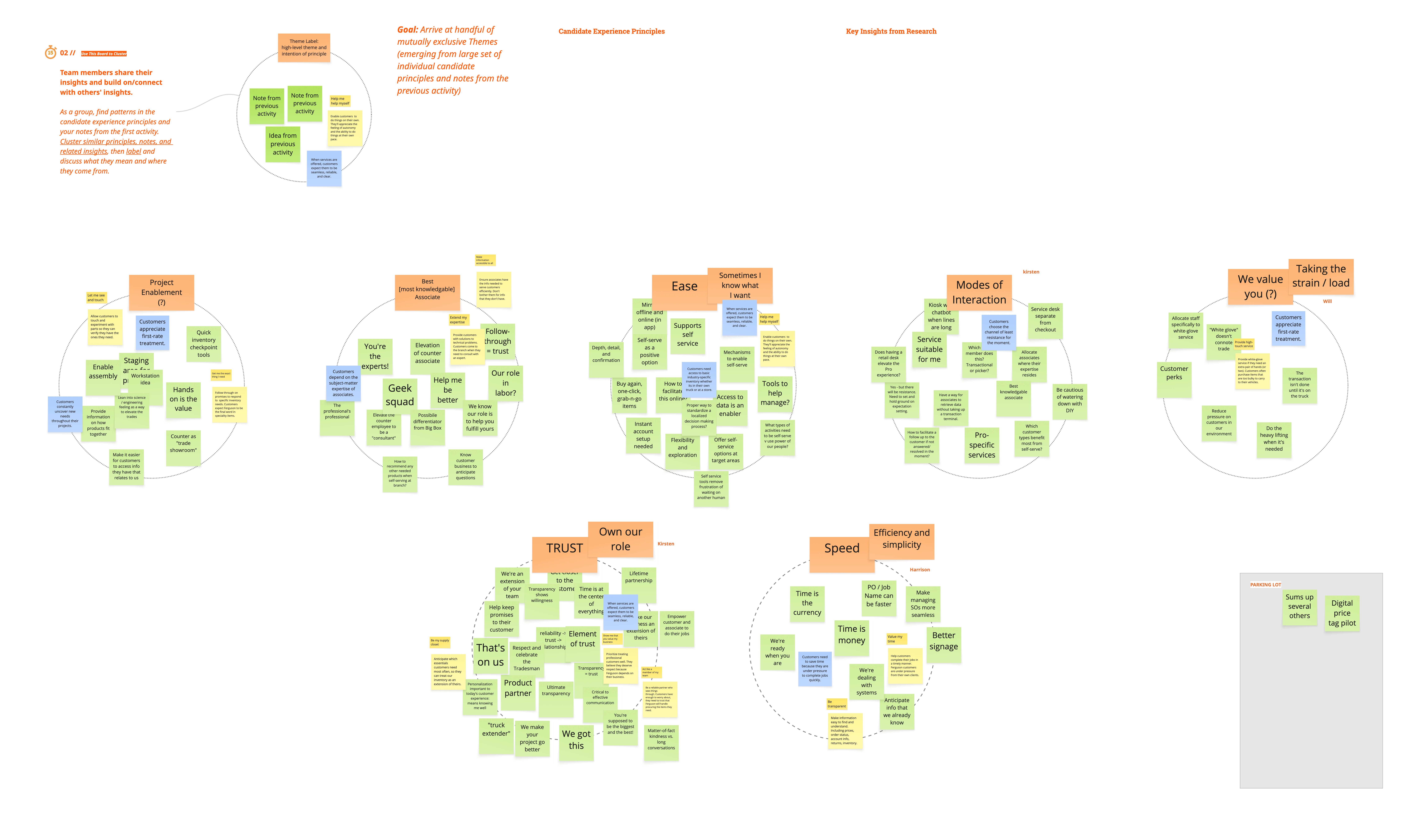
Reframing the work this way changed the design problem entirely. The job stopped being “reduce or distract from waiting” and became “prevent the two moments where waiting becomes betrayal.” Every prototype that came after was a response to a specific service breakdown, not a generic wait-time experience.
Translating “perception of waiting” into two named service breakdowns was what made everything downstream possible. Without that reframe, the engagement produces a worse version of the original brief: nicer waiting areas, signage, distraction. With it, the engagement produces two prototypes that fix specific operational failures.
Two named prototypes, deployed in real branches.
Both prototypes went live in their designated branches and were tested with real customers who didn’t know they were part of a study.
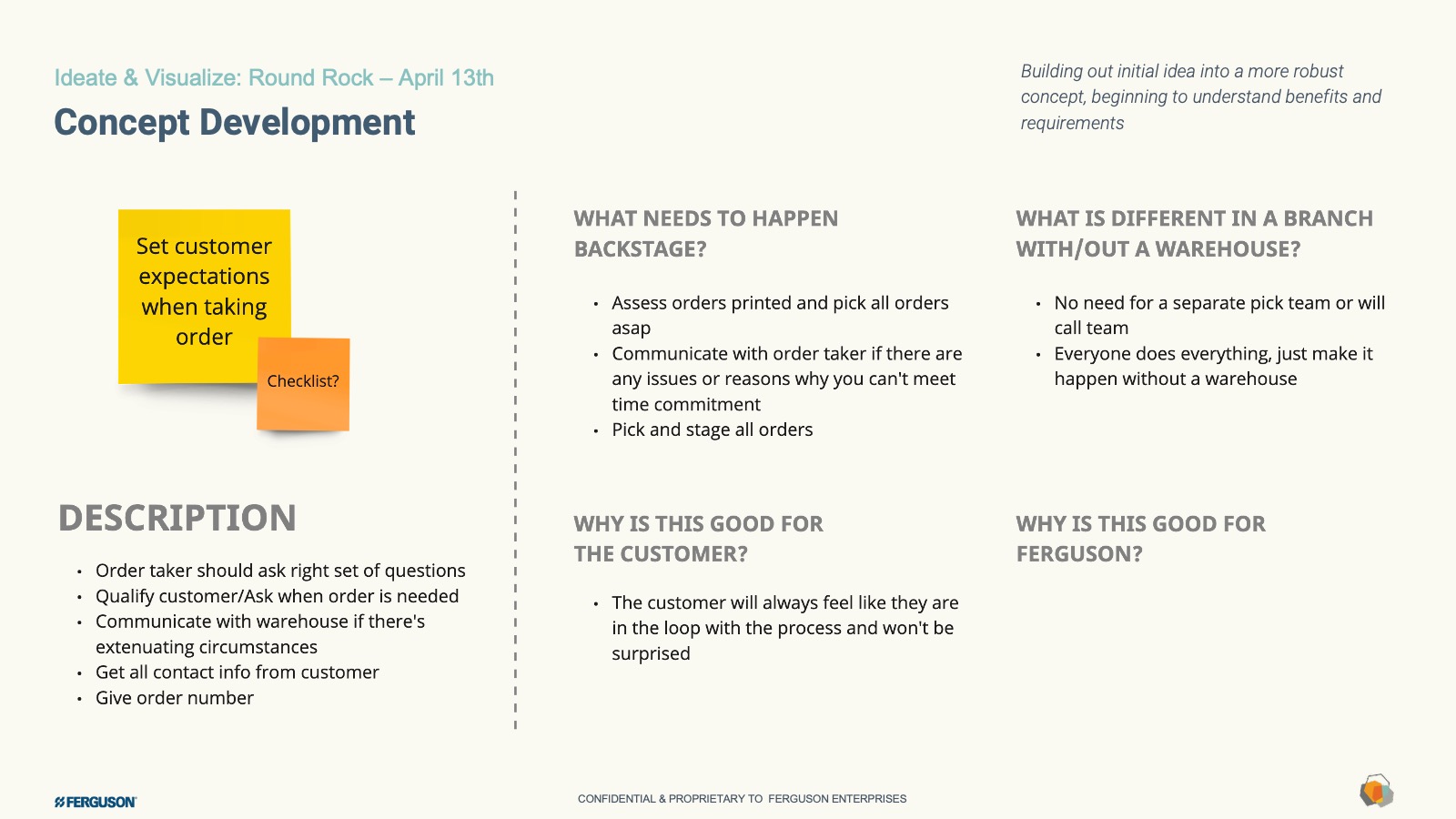
Make-It-Happen, Round Rock, TX
Targets the Order Not Ready scenario. It’s a coordination system with three working parts. A dedicated Microsoft Teams channel, limited to PPU specialists, where sales reps can confirm the team’s ability to meet a customer’s timeline before committing to it. Automatic short-pick email rules that notify a designated dispatcher when an order can’t be fulfilled in full. And a Sales Rep Flowchart that walks associates through every order-related task that wasn’t otherwise captured in Trilogie or Dynamics.
Met all 5 of its design criteria.
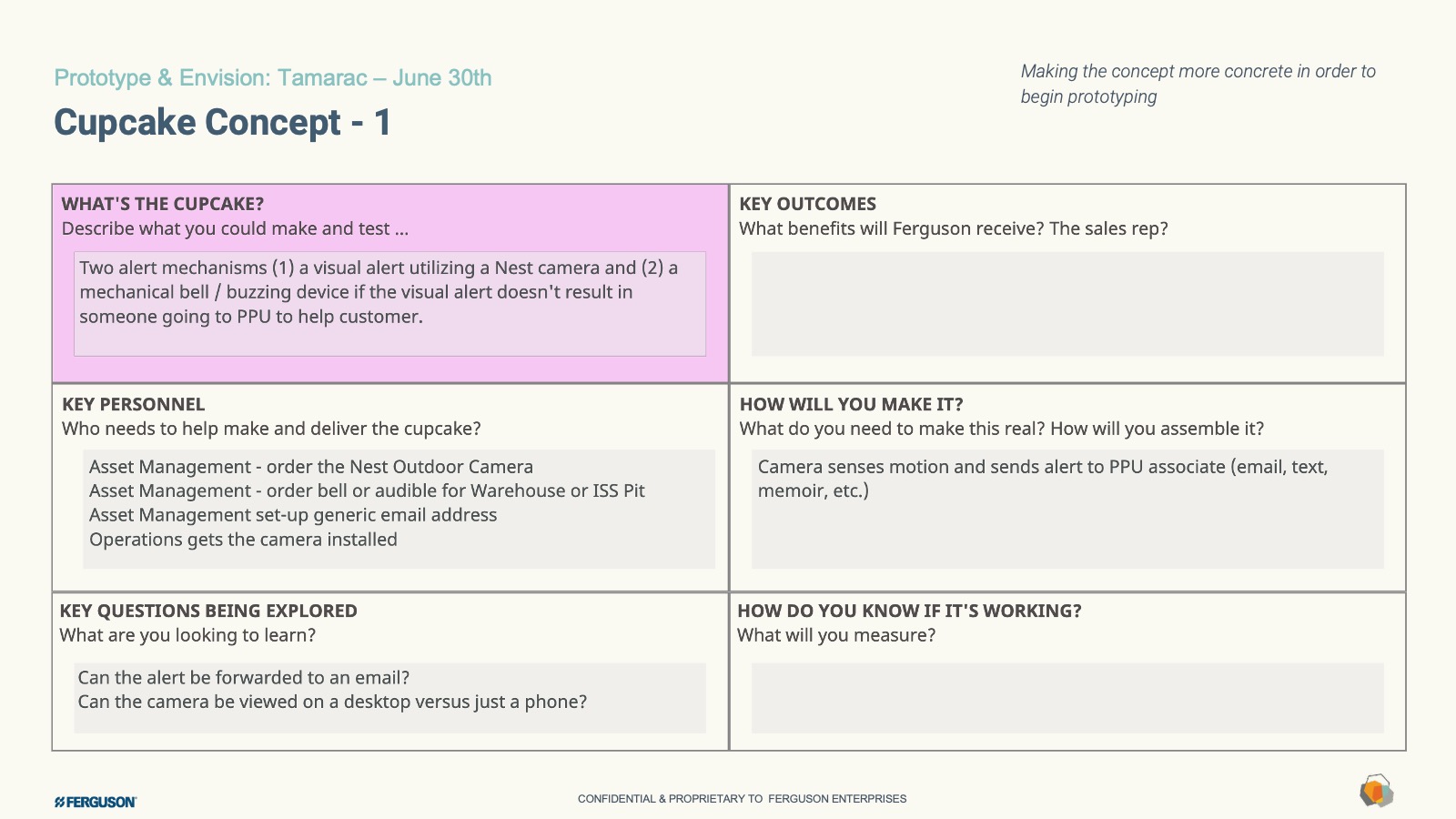
KnockKnock, Tamarac, FL
Targets the Associate Not Present scenario. A weatherproof video doorbell with two-way intercom, mounted at the PPU pickup area, paired with a standard operating procedure for staff response. Two-way radios let associates coordinate without involving the customer. For branches whose existing Memor devices couldn’t support the alert app, the prototype added mobile devices preloaded with it.
Met all 7 of its design criteria.
The field staff started defending the work.
Participants came in skeptical of service design, especially the field staff who had never been part of work like this before. By the final round of presentations, they were the ones presenting their own concepts, with their own metrics, and they wanted to keep going. Solutions that had seemed too simple at the start now seemed worth defending.
It gives us a better way to look at things and help us along the process. Not telling us what to do, but helping you figure out what you want to do.
The work outlasted the engagement.
The handoff was the easy part to worry about, and turned out not to be the right thing to worry about. Both prototypes stayed in testing past the engagement, run by their respective branch leads with internal CX support.
The Round Rock team kept Make-It-Happen running and started taking it into nearby non-WMS locations. They added Commercial to the testing pool and were looking at Builder next, with a stated goal of getting it working across every Blended CG before expanding into other Texas markets. Tamarac kept testing KnockKnock and was actively looking at how to test it at busier non-WMS locations that weren’t fully staffed for Pro Pickup.
We have gone light years ahead in our communication by not just leaving them to work it out for themselves. We’ve not had the conflicts that we’ve had before. It’s created a bond with the sales force and our associates.
The CX leadership read on the engagement was clear. The service design approach gave the business a quick and low-cost way to test whether something was worth exploring further. Bringing field staff and HQ together in the same workshops produced visibility in both directions that the company doesn’t normally get. And the prototyping teams were now in a position to keep iterating on their own, with support rather than dependency.
The branch leads even asked, unprompted, about cross-pollinating the prototypes: trying KnockKnock at Round Rock and Make-It-Happen at Tamarac.